Editorial Board, Editorial, Table of Contents
Keywords:
informationAbstract
Dear Readers,
The transformations experienced by contemporary societies pose complex challenges that require comprehensive responses grounded in science, engineering, and technological innovation. The energy transition, environmental sustainability, urban mobility, and the rapid advancement of digital technologies create interdependent scenarios in which the generation of scientific knowledge plays a crucial role in guiding decision-making and fostering more resilient development models.
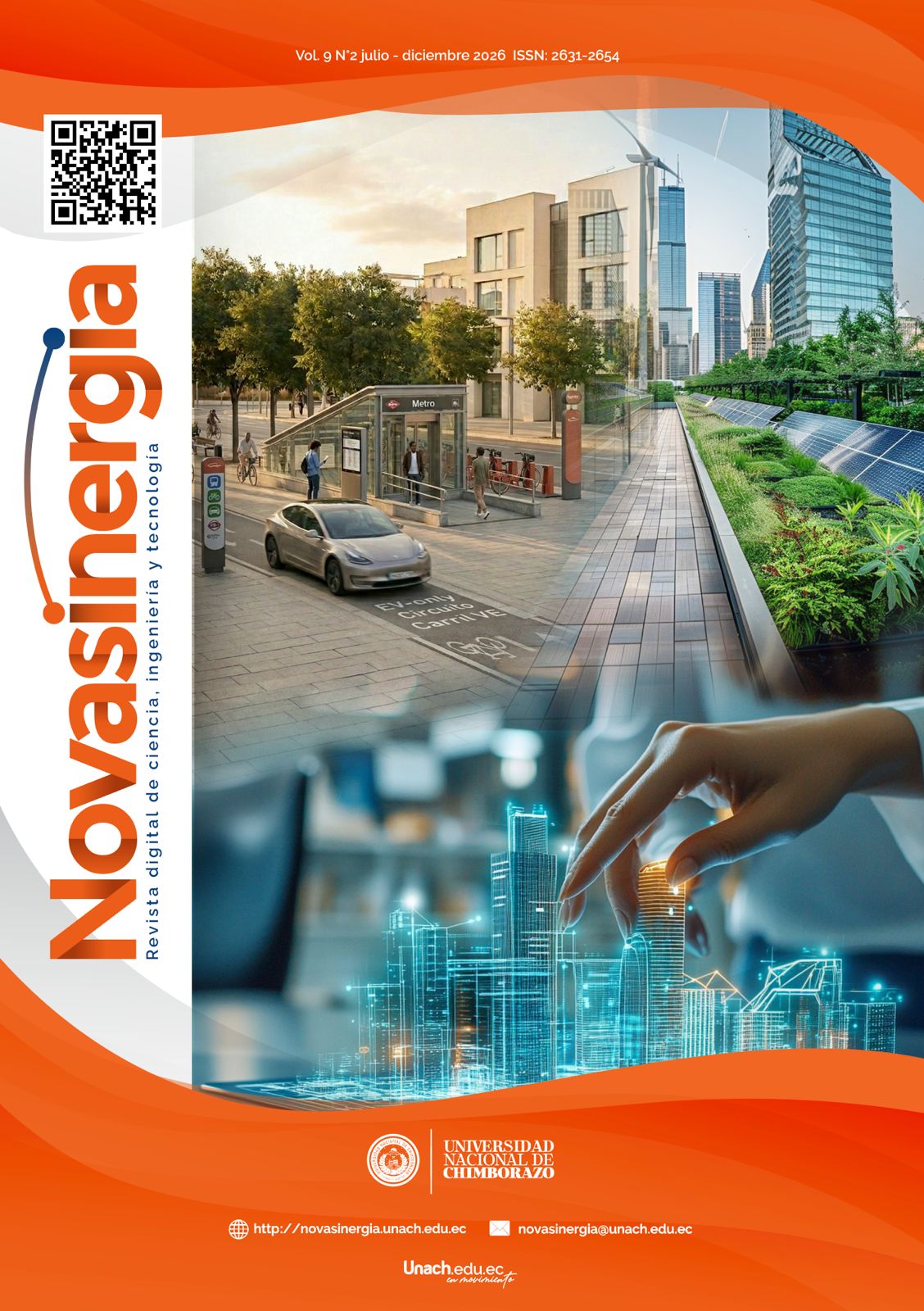
In this context, Volume 9, Issue No. 2 of Novasinergia presents valuable interdisciplinary contributions featuring robust scientific and methodological approaches to address issues of both global and regional significance. The published works reflect an increasing convergence between technological development, the sustainability of natural environments, and resilient social coexistence, all aimed at identifying solutions that promote collective well-being.
The first thematic area focuses on sustainable ecosystems, addressing challenges related to environmental conservation, efficient resource management, and the circular economy. The articles examine processes of forest cover transformation, eco-hydrological dynamics in high-mountain ecosystems, the energy recovery of plastic waste through pyrolysis, and the development of bio-based materials for sustainable packaging. These studies highlight the need to integrate environmental criteria into production processes and territorial planning, thereby strengthening strategies that balance economic growth, biodiversity conservation, and climate change adaptation.
The second thematic area addresses safe and sustainable mobility, an increasingly relevant issue in cities undergoing rapid urbanization and growing transportation demand. The published research examines both the transition toward electric mobility systems and public acceptance of new mass transportation infrastructure. The findings demonstrate that the mobility of the future depends not only on technological innovations but also on factors related to urban planning, multimodal integration, public policies, and users' perceptions.
The third thematic area brings together studies on emerging technologies, highlighting the role of artificial intelligence, machine learning, computer vision, predictive modeling, and advanced data analytics as tools for solving complex problems. The contributions range from the automated classification of sports techniques using machine learning to the modeling of electromagnetic fields in urban and educational environments, concluding with improvements in the reliability of electrical distribution systems through infrared thermography.
Additionally, this issue includes a reflection on the valuation of urban architectural heritage, emphasizing the importance of recognizing cultural and historical dimensions that are often overlooked in conventional heritage management processes. This contribution reminds us that sustainability also entails preserving collective memory and strengthening the identity of communities.
Taken together, the articles published in this issue demonstrate the interdisciplinary nature that characterizes contemporary research, where today's challenges are more effectively addressed through collaborative and integrated perspectives.
From an editorial standpoint, Novasinergia reaffirms its commitment to disseminating rigorous, relevant, and impactful research that contributes to scientific advancement and societal development. The consolidation of editorial practices based on international standards of quality, ethics, transparency, and open science remains a priority in strengthening the journal's visibility and international reach.
Finally, we invite researchers, academics, and professionals to engage deeply with the scientific dialogue fostered by the contributions presented in this issue, recognizing that the construction of sustainable futures requires technological advances accompanied by a comprehensive understanding of the interactions among society, territory, energy, and knowledge.
Ph.D. Broderick Crawford
EDITOR IN CHIEF
Ph.D. Lida Barba Maggi
EDITOR IN CHIEF
Downloads